

The Heist
A short-short story.

Lou gripped my shoulder and whispered about the "big score" as we eased up the dark driveway of the museum. The building was small, hexagonal, two floors, tucked between pine and sycamore. My phone told me it was 2:43 a.m. as I turned it off.
Donnie pulled the truck onto the grass and we slid out of our seats and crept across the wet lawn. We carried burlap sacks, trash bags, any container we could find in the garage where we first concocted the plan over shots of Old Crow. The museum had a back entrance and a cigarette butt-can propped open the door. Once inside we moved slowly, disjointedly, like there was something wrong with us.
It was my job to collect the Paul van Felis installation. I could barely see a thing, but the long strands of string were unmistakable, streaking from wall to wall, a multi-colored web woven with the creative tenacity of a bankrupt carmaker. I'd read in the newspaper the day before that van Felis used a mile of material, meticulously collected from yo-yos and mops and fishing rods, but I wasn't ready to believe it. I hated his work. I took a pair of scissors from my pocket and began to cut, letting the segments of string fall to the floor. I then looped them around some pencils that I'd brought. I separated it all by color as best I could, but the darkness, like the shape of a mouth, had its limits.
After twenty minutes, I tucked the spools into a trash bag. Then I slipped out into a passageway and walked along rows of empty white canvas – a Diane Rowrer exhibition, debuted two weeks prior – to the next hall where the others were working.
Donnie had stacked a dozen or so hub caps painted like nipples into a cardboard box when I approached. A Mercedes, crushed into a cube, stood beside him. We silently considered whether we could push it, whether it was a real Mercedes. Donnie, the smartest member of our crew, then slid his small hands into the tangled jaw where its hood might've been and extracted a shiny silver H in a square. I grinned, feeling the yellowness and weakness of my teeth, but Donnie couldn't see it.
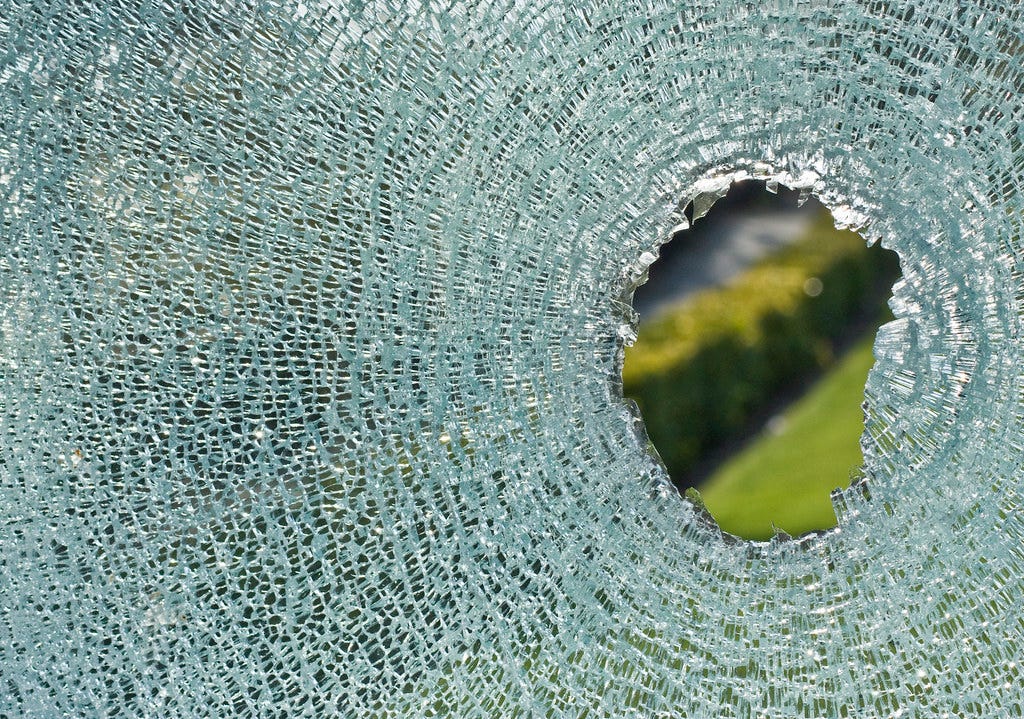
When we approached Lou, his ass crack was on display, bent over and meticulously plucking each glass shard that comprised Bethany Warren's piece. A Sick Man Out of Time, Warren had called it.
I picked up one of the shards and accidentally sliced my index finger on its thin edge. I tried not to react, keeping my face concrete, emotionless, like Warren would've liked. I loved her work. I licked the blot of blood and tasted the warmness of me. I then followed Lou’s lead and started shoveling as much glass as I could into the extra trash bag I carried. We grunted and gathered, even as the glass tore holes in our bags and put our entire operation at risk. "It's a fortune," Lou kept saying, his face red and slick with excitement.
Of course, I knew that the cameras were trained on us, sentinels in every corner, collecting our movements, cataloging every inch of our crime.
Two days later, I'd fold my hands on a table in an interrogation room and calmly tell the detective that I was a genius, a marvel, the greatest performance artist alive.